Humanism and the Death of God
Searching for the Good After Darwin, Marx, and Nietzsche
Humanism and the Death of God is a critical exploration of secular humanism and its discontents. Through close readings of three exemplary nineteenth-century philosophical naturalists or materialists, who perhaps more than anyone set the stage for our contemporary quandaries when it comes to questions of human nature and moral obligation, Ronald E. Osborn argues that “the death of God” ultimately tends toward the death of liberal understandings of the human as well. Any fully persuasive defense of humanistic values–including the core humanistic concepts of inviolable dignity, rights, and equality attaching to each individual–requires an essentially religious vision of personhood.
Osborn shows such a vision is found in an especially dramatic and historically consequential way in the scandalous particularity of the Christian narrative of God becoming a human. He does not attempt to provide logical proofs for the central claims of Christian humanism along the lines some philosophers might demand. Instead, this study demonstrates how philosophical naturalism or materialism, and secular humanisms and anti-humanisms, might be persuasively read from the perspective of a classically orthodox Christian faith.
Praise for Humanism and the Death of God
“For anyone committed to secular humanism, it remains disquieting, as Ronald Osborn insists, how difficult it is to defend notions of human dignity, inviolable rights, and basic equality without the religious imaginary thanks to which they all came to the world. … This book is finely wrought for both believers and skeptics alike.”—Samuel Moyn, author of The Last Utopia, Harvard University
“Original, deep, and balanced. The overall argument is compelling, never overstated. The breadth of literature brought into the discussion is amazing. The writing is superb.”—Nicholas Wolterstorff, Yale University
“The argument is simple, clearly written, broadly documented, and conceptually careful. … The retelling from the ‘slave revolt in morality’, retold from a biblical perspective, is stunning.” —Merold Westphal, Fordham University
“A compelling, carefully argued, and engagingly written critique of naturalism. While the author’s Christian convictions are evident throughout, this splendid work is emphatically not an apology for Christianity.”—Jens Zimmermann, Regent College
“This is a powerful, indeed brilliant book. It is, in sharp contrast to most academic books, a pleasure to read.”—C. Stephen Evans, Baylor University
“A probing, thoughtful, and highly engaging reflection on the crisis of secular modernity that Charles Taylor identified as its lack of the moral resources it needs to realize its own ideals of universal justice and benevolence.”—Bruce K. Ward, Laurentian University
“When a book contains impressive erudition, careful analysis, felicitous writing and a clearly stated thesis, a wide array of students and scholars should read it. Ronald E. Osborn’s Humanism and the Death of God is such a book.”—James J. Londis, Reading Religion
“Osborn covers ground familiar to students of the Enlightenment, but he does so with such clarity, depth, candor, and feistiness as to repulse the sense of the commonplace and intensify the urgency of the message, both for the wider society and for the church itself … Humanism and the Death of God belongs in the library of every pastor whose congregation needs a reminder of its relevance and responsibility.”—Charles Scriven, The Christian Century
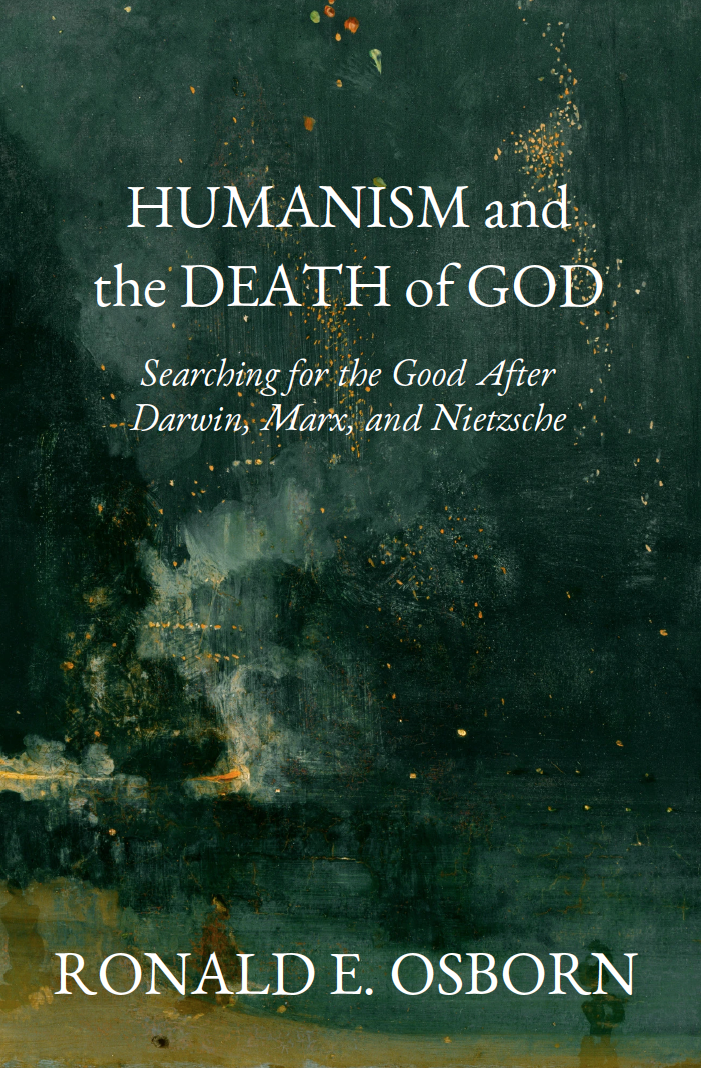
- Hardback edition: Oxford University Press, 2017
- Paperback edition: forthcoming
 Ronald E. Osborn